flowchart LR
    A[1962.08.XXX] --> B{In PastPerfect?}
    B --> D[Yes]
    D --> F{Assiged to Amador?}
    F --> Yes1[If Yes then Leave Number\nand update record if necessary]
    F --> No1[Assign to Amador\nand update record if necessary]
    B --> E[No]
    E --> G{FIC & Reaccessioned?}
    G --> Yes2[If Yes then \nreassign to 1962.08\nand update record if necessary]
    G --> No2[Flag Object as Missing]
The University Museum (UM) was founded in 1959, and “started collecting artifacts before there was ever a building into which they could be placed” (Baker 1997, 7). By 1960, the UM gained both its first significant collection1 and two storage facilities: the Old Bus Garage and Old Carpenter Space. By 1962, the UM moved to the Seed House.
2.1 Initial Receipt of Objects by UM in 1962
In 1962, the UM accepted a sizable number of items from the Amador House, La Casa del Jardín (Camien 1962); this is accession 1962.08 (Section 3.1). Over the ensuing years since 1962, the UM changed locations at least three times before arriving at Kent Hall (KH) in 1981 (Baker 1997),2 and the museum’s numbering system changed radically at least twice. Over time, through these and other processes, many Amador objects became disassociated with their documentation. Part of the current research by the museum is to re-identify Amador related items and reassign them to the collection.
2.2 Inventories between 1962-1999
From ongoing review of museum documents, it appears that between 1962-1999 there were multiple attempts to conduct comprehensive inventories of the UM collections. From paper records, it looks as though a major inventory was undertaken in 1979. Though difficult to reconstruct, this inventory may have been initiated in anticipation of the move to KH which occurred in 1981 (Baker 1997, 17).
By the early 1970’s, it appears that some items recovered from the Amador House and accessioned by the UM had already become disassociated with their original accession records. In 1974 some of the items initially accessioned as 1962.08 were reaccessioned as found-in-collections (FIC) (i.e. 1974.01). This implies that the objects were disassociated with their paper records, and the individual(s) performing the inventory, did not or could not, reconstruct the connection. Therefore, a new tracking number was used, and the object designated as FIC.
Note 2.1: Found-In-Collections (FIC): Definition and Procedures
- FIC definition
-
“Undocumented objects are mysteries that can sometimes be solved so that the undocumented object is restored to its corrects status, but if the mystery cannot be solved, the object should properly be considered a found-in-collection (FIC) object” (Buck 2020, 29.3).
- FIC Procedures
-
“If original documentation is found for an object that has been tracked or accessioned into the collection using a FIC number, the object should be returned to its original number and the FIC number retired” (Buck 2020, 29.35).
Following Museum Registration Manual recommendations, as part of ongoing collection rehabilitation efforts, where possible objects logged as FIC are returned to their original accession number and the FIC number is retired (Note 2.1, Figure 2.1).
2.3 UM Curates “Everyday Life at ‘El Jardin’” 1999
In 1999, UM Curator Terry Reynolds Figure 2.2 curated an exhibition entitled “Everyday Life at ‘El Jardin’.” Outgoing loan documentation for the exhibition indicates that 48 objects were to be displayed at the Old Amador Hotel which in 1999 was serving as the Doña Ana County Manger’s Complex. According to Reynolds correspondence found in museum records, the exhibited objects were recovered from the basement of the Amador House and “they represent everyday life at El Jardín.” Among the everyday objects displayed in the exhibition were a coal heated iron and a washboard.
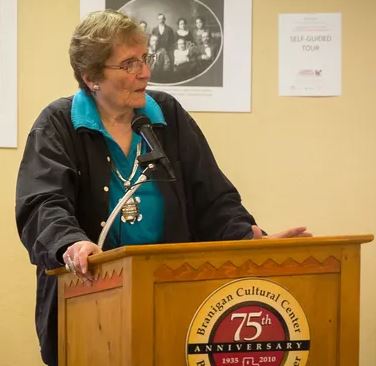
2.4 UM Undertakes a Systematic Inventory 2021-2022
In 2021, under the initiative of former UM Curator Dr. Kristin Otto, the UM began the multi-year process of systematically inventorying the museum’s entire permanent collection. This effort was supported by Institute of Museum and Library Services (IMLS) Inspire! Grants for Small Museums Award IGSM-248937-OMS-21 to Dr. Otto. This grant funded a systematic inventory of ethnographic and historic objects housed in KH. At the completion of the process (Johnston 2023), 4415 objects were registered and made available on a searchable user interface.
Though the criteria of what constitutes the Amador collection was never formally defined during the historic and ethnographic inventory of 2021-2022, 68 objects were logged as belonging to the “Amador Collection” (\(n\)=59) “Amador-Selso Collection” (\(n\)=8), or “Amador” (\(n\)=1). Two additional objects were identified as having been donated by “Hendrick Amador Tucker” are part of the “Pottery of the Americas” collection, but are not included in any of the three aforementioned collections. Paper records at the UM suggest that there were many more items in the Amador collection than what was captured by the inventory efforts conducted under IGSM-248937-OMS-21. In correspondence on file at the UM Reynolds (2020) estimated that there were about 600 items in the Amador Collection but that the collection is complex and that it would be difficult to relocate all of the items. As an example of this complexity, even during recent times, during the 2021-2022 IMLS funded inventory, accession 1973.03 was flagged as FIC. However, review of museum records performed under the NMSU Research Administration Service (RAS) seed grant of F23/S24 (Section 2.6), quickly revealed that accession 1973.03 is composed of objects recovered from the basement of the Amador House and was a transfer of objects from the NMSU Archive to the UM (Section 3.6). During S23, UM student staff reassigned accession 1973.03 to the Amador Collection (Figure 2.1).
2.5 UM Collection Description 2020-2023
The following text was copied from the University Museum’s website page on the Amador Collection in 2023. The text was posted to the UM website by Dr. Otto and is reproduced here for archival purposes.
Click to show website text
The Amador family was one of the most prominent Spanish families to have first settled Las Cruces around the late 1850s, as well as being one of the best historically documented. The University Museum acquired 600 items from the Amador family home before it was razed in 1962. The Amador collection contains clothing and textiles, children’s toys and dolls, housewares, and miscellaneous items such as fans. The decedents of the Amador family still continue to donate cherished heirlooms to the museum; therefore, we have been able to preserve a fair amount of history and memories pertaining to the Amador family, one that reflects the origins of the city of Las Cruces.
Many of Martín Amador’s accomplishments secured the future existence of Las Cruces, such as owning a mercantile in Silver City and Las Cruces, several farms in Mesilla Valley, served on several civic commissions and committees, donated money to start the first public school system in Las Cruces, and if that wasn’t enough, Martín donated a considerable amount of land that would then bring the railroad system to Las Cruces in 1881.
The Amador House, which was completed in 1879 then demolished in 1962, was known as La Casa del Jardín for the elegant garden that was established there for his wife, Refugio Ruiz. Martín and Refugio both passed in the early 1900s, but their two youngest daughters of five that lived to adulthood, inherited the home. Clotilde and her husband were the last to live in the Amador house, until Clotilde passed in 1960.
In a 2006 article in La Herencia written by one of the University Museum’s prior curators who has been dedicated to researching the histories of El Paso del Norte, Mesilla Valley, and particularly the Amador family, Dr. Terry R. Reynolds writes, “Rather than storing fruits and vegetables in ground floor rooms, Clotilde had collected photographs, newspapers, catalogs, magazines, and various bits and pieces of household goods and furnishings. This material was unsuitable for auction, and her descendants gave the New Mexico State University Library permission to search among these rooms for items of historical value. Two truckloads of paper and objects were taken to the university, where all the objects of historical significance were catalogued and stored by the NMSU Museum.”
Our collection at the NMSU Museum combined with the NMSU Archive and Special Collections located in Breland Library together form the best documented 19th century Hispanic Family history available. The Amador Hotel and Foundation still stands.
2.6 Amador Collection Research Administration Services (RAS) Seed Grant 2023-2024
In 2023, with support from NMSU’s Research Administration Services (RAS) the UM initiated a focused Seed Grant project to rehabilitate the Amador Collection. To the best of Craig’s knowledge, criteria that define the Amador collection were never formally defined. As an initial step of Amador Collection rehabilitation Craig felt it necessary to explicitly define the Amador Collection (Note 2.2) and did so based on the object originating from an Amador property or having been donated by a close relative of the Amador family.
Note 2.2: Collection Definition
As of 2024, the UM Amador Collection is defined as:
- objects recovered from an Amador property or
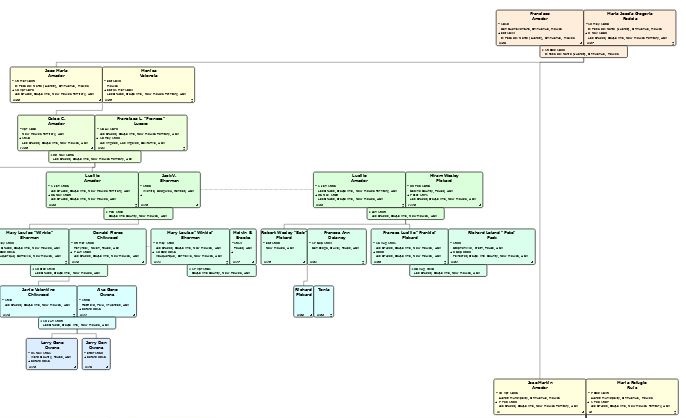
- items owned by a direct consanguineal or affinal descendant of Martín Amador or Refugio Amador de Ruíz (Figure 2.3).
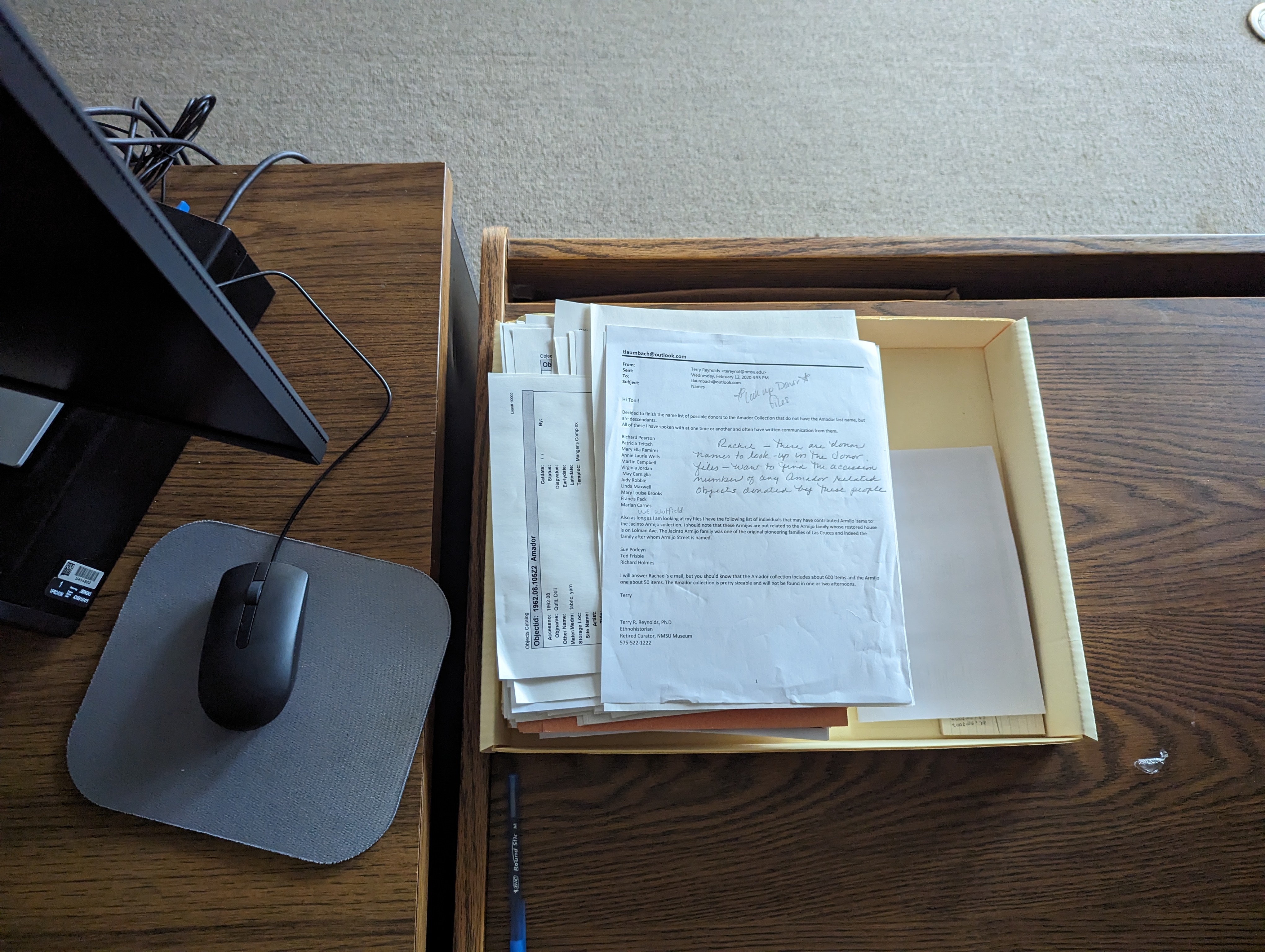
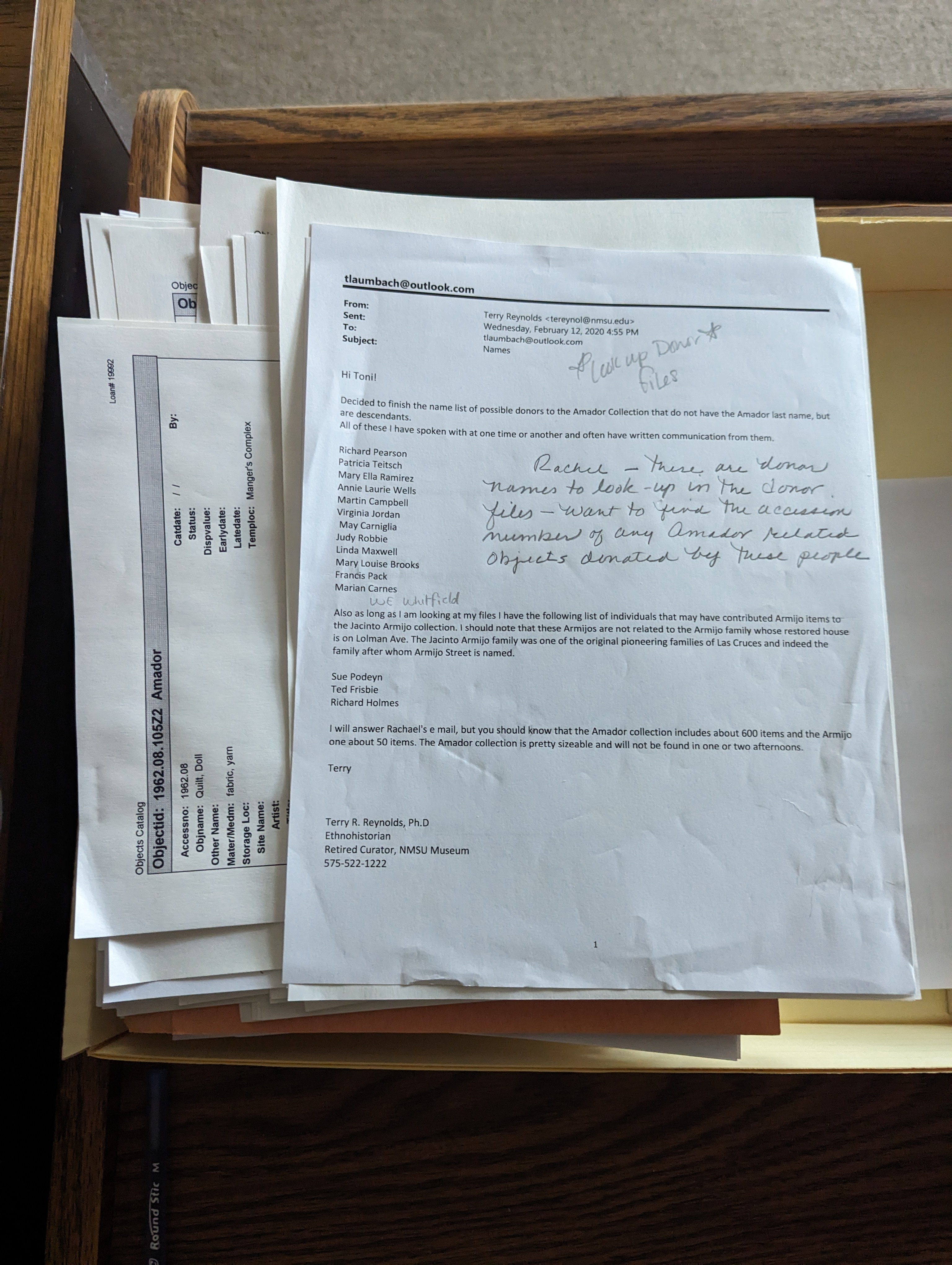
During the Fall 2023 Semester, graduate student Jonathan Gilbreath reviewed various paper records related to the Amador collection and attempted to cross check records to attain an accurate assessment of the collection (Figure 2.4). Note that Figure 2.4 (b) shows a 2020 email from former curator Terry Reynolds to Toni Laumbach (former Chief Curator at the New Mexico Farm & Ranch Heritage Museum), and there is a hand written note to “Rachel”. Rachel Cover was Interim Curator of the UM from 2019-2020. It is Craig’s understanding that these documents (Figure 2.4) were piled up in KH 210 since at least 2020. During Spring 2024, undergraduate student Emma Alvarez de La Rosa embarked on the process of defining the key accessions involved and updating object records to better reflect Amador Collection holdings at the UM. A great deal of this collection rehabilitation work involved searching through UM collections areas (primarily the Basement and Textile Room) to track down objects because most items were lacking location information—even those entered into PastPerfect. During Spring 2024, Gilbreath supported the Amador inventory work by scanning early accession binders (Section 2.6.3). As students processed portions of the collection, paper records (i.e. Figure 2.4) were properly refiled. All work was supervised by Craig.
2.6.1 Basic Research Questions for RAS 2024 Seed Grant
The primary purpose of the RAS 2024 Seed Grant was to rehabilitate the Amador collection. This work involved a set of simple and fundamental questions about the Amador Collection:
- What does the UM have, and where are the objects located?
- How did those objects come into the museum?
- What object documentation exists at the museum?
Additional ancillary lines of investigation regarding the Amador collection includes but is not limited to identifying prior research done on the family, the properties, and the objects in the collection (Chapter 4).
2.6.2 Spring 24 Student Plan Of Action
The following outline serves as a general plan of action for students working on the project during the Spring 2024 semester.
- Learn about the Amador family by reading select texts and visiting “The Amadors: Family, Culture, and Identity in Early Las Cruces” exhibition at the Branigan Cultural Center from 2023-10-20 through 2024-01-13.
- Develop an understanding of the current project by cultivating knowledge regarding the history of the family in relation to the University Museum as well as the work of past Directors (i.e. Camien) and Curators (i.e. Reynolds).
- Start inventory work by identifying the major accessions involved in the Amador collection.
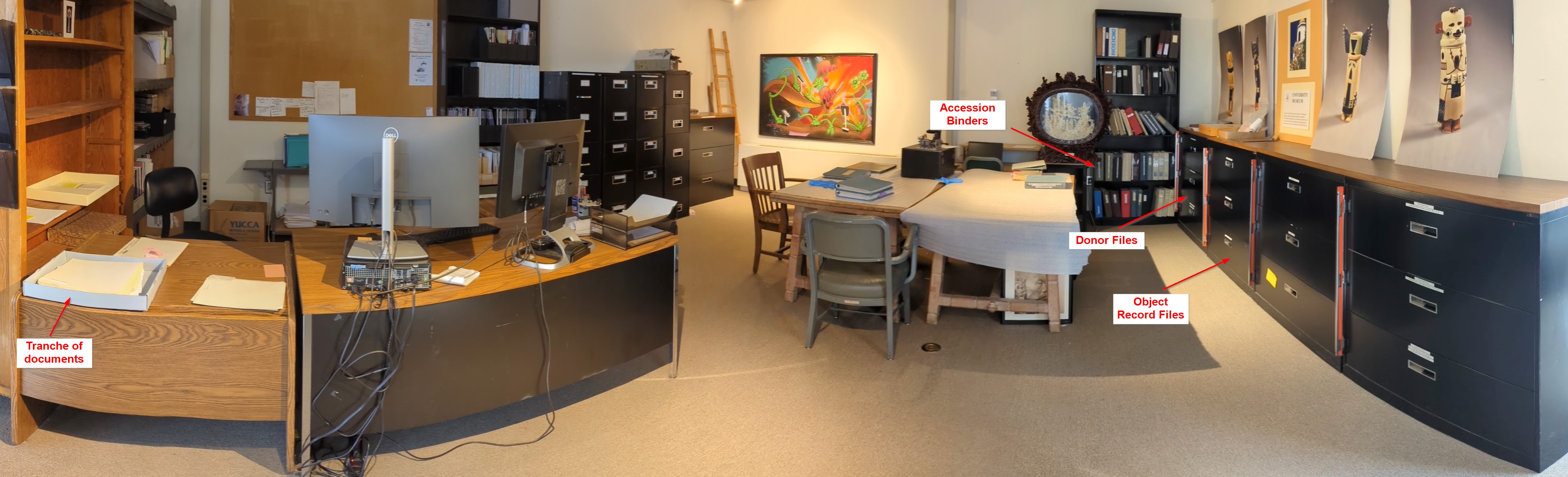
- Do this by reviewing object numbers to look for the most common accessions. Gilbreath’s Excel sheet is based on the papers stacked on the Registrar’s desk (Figure 2.4; and Figure 2.5). He cross checked these records against information from the binders and folders in KH 210 as well as the museum’s database PastPerfect.
- Make note if the objects meet the criteria for inclusion in the Amador Collection related accessions. This means they came from an Amador property or a member of the Amador family (Note 2.2).
- If it is an Amador Collection accession, then review that accession’s paper records: binders and folders located in the North-East corner of KH 210 (Figure 2.5).
- Look for conflicting numbers and note them if encountered.
- Document in PastPerfect what can be gleaned about the accession through a review of paper records.
- When appropriate assign the objects to the Amador collection.
- Ensure that digital object records are properly formed and that all avaliable information is filled into the appropriate fields.
- Ensure all collection objects are photographed and the photograph is loaded into PastPerfect.
2.6.3 Accession Binder Document Scanning
Jonathan Gilbreath noticed that in consulting older paper records, records were beginning to show wear and tear. Older records in particular were suffering. To scan these records Craig obtained a CZUR ET24 Pro document scanner and Gilbreath undertook scanning of all object accession binders (Figure 2.6). This work is about half complete and ongoing.
flowchart LR

Binder[Accession\nBinder] --> Scan[Scan with\nCZUR ET24 Pro] --> OCR[OCR in\nCZUR Scanner] --> Annotate[Annotate\nDocument\nin Acrobat]
Gilbreath scans the binder using the Czur Scanner software with the following scanner settings:
- Frequency: 60Hz
- Resolution: default 24,000,000 (569x4272)
- DPI: 1000
- Image format: JPG
- Image quality: best
- Paging settings : automatically create separate pages; left to right, left page comes first
- Black and white: standard
Initially the scanned files were exported to PDF directly in the Czur Scanner software using default settings. However, it was apparent that “under the hood” compression was rendering hand written text illegible. This is a significant problem because while most records are typed, many are hand written and even those that are typed often contain hand written annotations which are important to retain in the digital copy. Setting the Image processing mode to Keep original image largely solved this issue. Craig and Gilbreath experimented with OCR settings and use the following parameters when exporting to PDF:
- Language: English
- Export file type: PDF
- Image processing mode: Keep original image
- PDF quality: Medium resolution (this did not seem to degrade the image quality)
Once the PDF is created in the Czur Scanner software, it is then opened in Adobe Acrobat where annotations are applied to the pages as necessary.
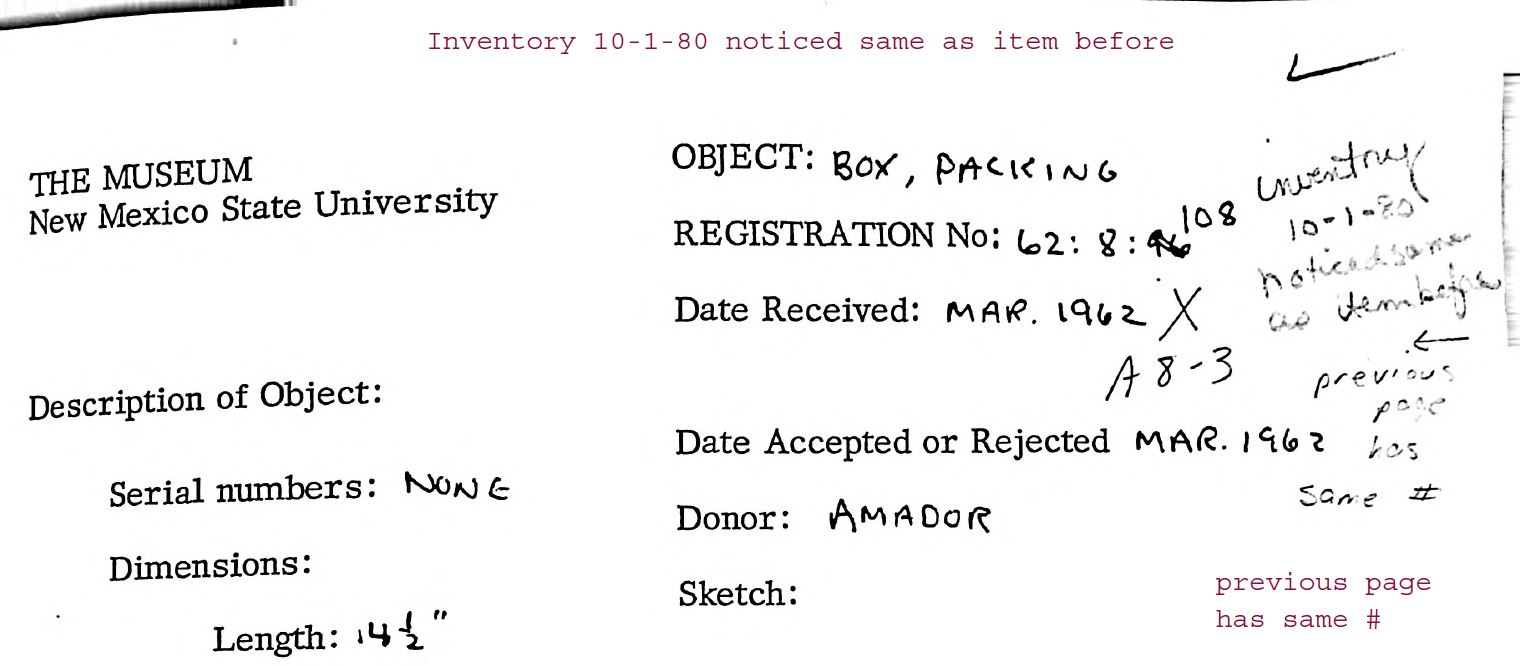
Annotations are added as comments or text boxes (Figure 2.7). To create the annotation, activate the comment tools, select the add text comment tool, then put the cursor where desired, then click and type the annotation. Courier is used as the font because it is the closest to the original typeface in the documents. Text is assigned RGB Color code= 140,11,66 which is part of NMSU’s official color palette.
In terms of OCR, we got better results from the CZUR Scanner software than Adobe Acrobat. This came as a surprise to Craig. CZUR Scanner uses ABBYY® OCR which seems to do an exceptional job on these older documents. However, handwriting is not recognized.